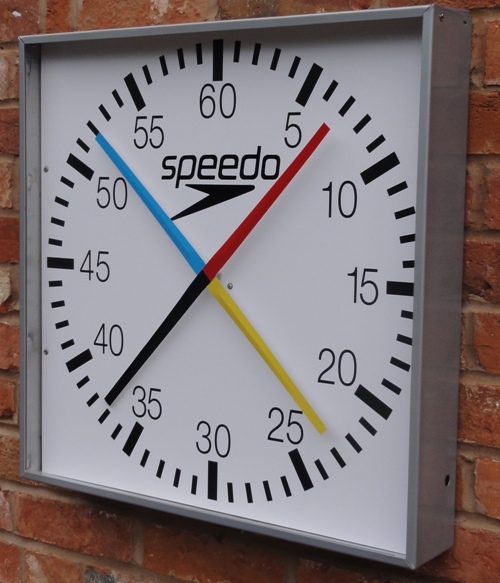
You can use a pace clock for a few functions. Monitoring your speed and managing intervals are two key uses.
Timing Yourself
If you’re wondering how fast you’re swimming, you can utilise the pace clock to find out your speed. Knowing your speed is a good indicator of how well you’re swimming. If you’re faster today than you were yesterday, you should work on your stroke or practice habits. If your times are improving, you know that you’re on the right track.
The best way to get your time is to leave on “the top”. Leave the wall when the second hand gets to the 60. After you’ve swum the distance that you want to time, glance back up at the clock. This will help you determine what your time is.
For example: Say you’ve sprinted a lap of freestyle. When you touched the wall, the second hand was at the 23. That means you swam the lap in 23 seconds.
It gets more complicated if you leave the wall at a different time. If you left the wall on the :10 and touched the wall on the :37, then you’ll have to do some math to figure out your time. Take the first number and subtract it from the second to get 27. This means you swam the lap in 27 seconds.
Swimming Sets
Another instance where you’d use a pace clock is if you’re using intervals in practice. When keeping track of intervals, you’ll have to do some math.
For example: If the interval is the 45, then that means you’ll leave 45 seconds apart for each repeat. Say you leave on the :15 for the first repeat. You’ll add 45 seconds to that to figure out when you’ll leave for the second repeat. That means for the second repeat you’ll leave on “the top.” For the third repeat, add another 45 seconds to leave on the :45 and so on.
Hot Tip: If you’re not comfortable reading the clock yet, have someone else go first in the lane. That way all you have to do is follow their lead. Make sure that you leave 5 or 10 seconds after the person in front of you.
If you’re still confused, think about it like this: If you left your house at 7:00 and you need to be somewhere in 45 minutes, you’d have to be there by 7:45. Use this same math when you’re reading the pace clock.